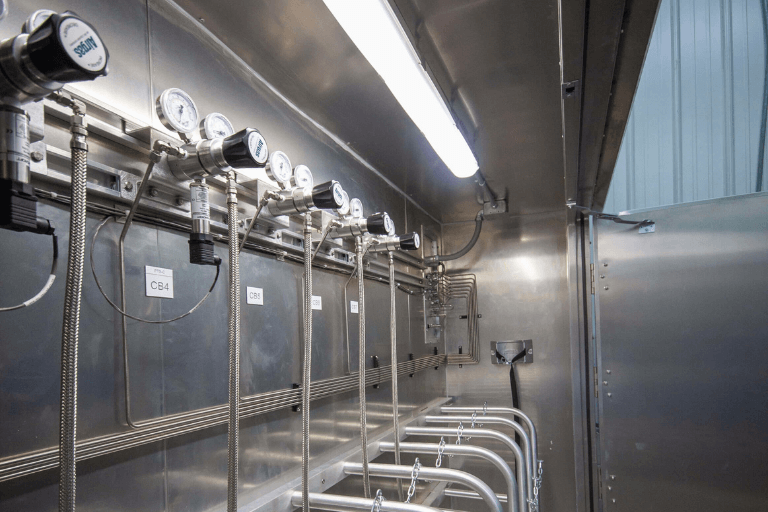
What Is Calibration Testing?
Calibration testing involves comparing your analyzer’s response to a known reference—either a calibration gas (for gases like NOx, SO2, or CO) or a reference signal (for flow or opacity). This process detects whether the instrument is reading accurately and whether it’s still operating within the required performance specifications.
A valid test must:
- Include zero-level (0–20% of span) and high-span (80–100% of span) evaluations
- Be completed within the same or adjacent clock hours
- Result in calibration errors (CE) that meet EPA tolerance limits
These performance tests are required daily, during 7-day drift tests, cycle/response time tests, and after any maintenance or non-routine adjustments.
New to Calibration Gas? Learn More About Part 75 vs Part 60 Requirements.
Before diving into general calibration testing requirements and compliance tracking, make sure you're familiar with how calibration gas is selected, blended, and used in CEMS, including the different requirements for Part 60 and Part 75 calibration daily checks and quarterly audits.
The Difference Between Calibration Checks vs. Calibration Tests
Calibration checks are often part of the daily routine—used to ensure the system is still operating within acceptable bounds. These include:
- Verifying zero/span levels
- Reviewing for drift or interference
- Tracking routine vs. non-routine adjustments
Calibration testing, however, refers to a broader set of required evaluations used for compliance and certification, including:
- Performance specification testing
- Cycle/response time testing
- Drift assessments over multiple days
- Post-repair or replacement verification
Both are essential, but calibration testing serves as the proof of compliance, while checks serve as ongoing monitoring between those proofs.
Common Types of Calibration Tests
Daily Calibration Checks
A calibration error test should be performed on each gas, moisture and flow monitoring system on a daily basis. It includes:
- Gas analyzers: zero and span validation (Part 75 and Part 60 Systems have different requirements)
- Flow monitors: interference check plus zero and span testing
- O2 analyzers: may use 20.9% O2 gas if span ≥ 21.0%
- Results must be recorded in your Quarterly EDR
7-Day Calibration Drift Test
This test ensures your analyzer doesn’t drift outside allowable performance limits over seven consecutive operating days.
- Required for all analyzers and flow monitors
- More stringent than daily tests (half the performance spec tolerance)
- No adjustments are allowed before testing begins
Cycle/Response Time Test
Confirms the analyzer reacts to gas concentration changes in ≤ 15 minutes. Both upscale and downscale response times must be tested for dual-range analyzers. This is essential for facilities that must prove rapid instrument responsiveness during operational fluctuations.
Probationary Calibration Testing
Used when a system fails a recertification test or has undergone repairs. This test confirms that the equipment is operating correctly before returning to active monitoring. If all the required tests are completed after the probationary calibration is passed, then all data from the time of the probationary calibration is considered valid data.
Offline Calibration Testing
Offline calibrations can be used when the unit isn’t running, but only if your facility has passed an initial offline calibration demonstration test and reported it in a quarterly report.
To keep data valid:
- An offline calibration must be passed within the last 26 clock hours, and
- An online calibration must be passed within the last 26 unit operating hours.
If either condition isn’t met, the data becomes invalid until both calibration tests are completed successfully.
What Happens When a Calibration Test Fails?
When calibration errors exceed EPA-specified limits, data from that monitor becomes Out-of-Control (OOC). This status remains until a successful retest is completed.
Additionally:
- If a calibration is missed beyond the 26-hour window or the 8-hour startup grace period, data becomes invalid
- Failed flow monitor interference checks also result in OOC data
- Corrections made during the same hour as the test may retain valid status if minimum data criteria are met
Key Takeaways
- Air emissions calibration testing is required daily, quarterly, and annually to ensure accurate CEMS performance and meet Part 60 and Part 75 requirements.
- Tests include zero/span checks, drift tests, interference checks, and response time tests.
- Calibration gas must meet EPA Protocol requirements and be introduced at the correct entry point in the system.
- Offline calibrations can be used if a demonstration test is passed and both 26-hour timing rules are met.
- Automating calibration testing with a Data Acquisition System (DAS) like StackVision reduces manual effort, tracks OOC events, and helps facilities stay compliant.
Do you need a more efficient way to manage your calibration requirements? Book a demo of StackVision today to see how automation simplifies compliance.

Taylor Hempel - Marketing Specialist II
Taylor Hempel is a skilled marketer specializing in content creation, social media management, and driving customer engagement. With a BBA in Marketing from the University of Texas at San Antonio, she joined ESC Spectrum in February 2022. Taylor is adept at crafting informative content about continuous emissions monitoring systems, its components and data acquisition systems allowing her to craft content that educates and informs industry professionals.
Contact Taylor at thempel@escspectrum.com for questions or comments.